
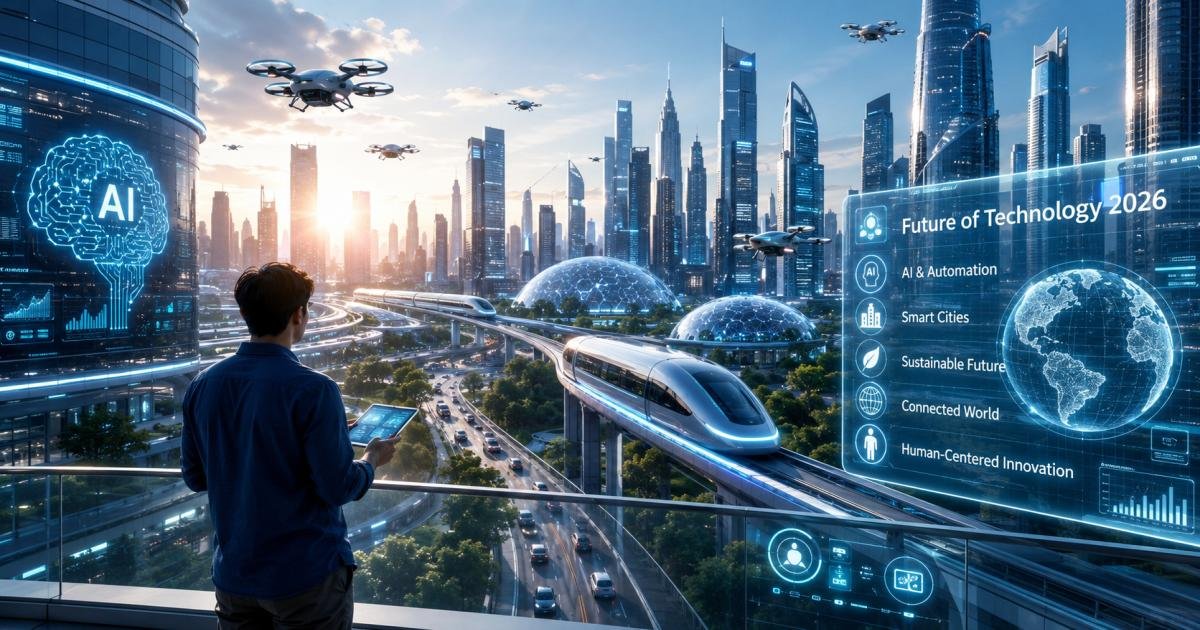

Technology does not wait for anyone. It moves fast, breaks old rules, and builds new paths. In 2026, this pace is faster than ever before. Techslassh.com – Future of Technology is not just a phrase. It is a real look at what is coming next, and how it affects your life, your job, and the world around you.
Why Technology Is Changing Faster Than Ever
Think about this. The telephone took 50 years to reach 50 million users worldwide. The internet achieved this in seven years. A leading generative AI tool reached about 100 million users in just two months. Today, that same tool has over 800 million weekly active users, roughly 10% of the world’s population.
That speed is not slowing down. It is getting faster. New tools, new systems, and new ideas arrive every single week. If you blink, you might miss something new, something big.
The Role of AI, Automation, and Intelligent Systems in 2026
Artificial intelligence is no longer a future dream. It is here, and it is everywhere at this time. From your phone’s voice assistant to factory robots, AI powers more of your daily life than you realize. In 2026, Artificial Intelligence (AI) has moved beyond simple chatbots. It now makes decisions, manages workflows, and even collaborates with other AI agents without human help.
Automation is no longer just about replacing a single task. It is about entire systems running smarter, faster, and with fewer errors. Hyperautomation the idea of automating everything that can be automated is now a real business strategy, not just a buzzword.
What You Will Learn From This Guide
This article from Techslassh.com – Future of Technology covers:
- What the future of technology really means in 2026
- The biggest trends shaping industries & daily life
- Artificial Intelligence (AI) innovations that are leading the next tech era
- How Artificial Intelligence (AI) agents are changing the way we work
- Technologies expected to grow rapidly by 2030
- How major industries healthcare, education, finance, and more are being transformed
- The future of cybersecurity in an Artificial Intelligence-driven world
- Smart cities and the connected future
- India’s growing role in global tech innovation
- Challenges, predictions, and how to prepare
Techslassh.com’s Perspective on Future Technology
At Techslassh.com, we believe technology should serve people, not the other way around. The future is not just about faster chips or smarter algorithms. It is about how these tools improve human life. This guide is written for everyone: students, professionals, business owners, and curious minds who want to understand where the world is heading.
What Does the Future of Technology Really Mean in 2026?
The phrase future of technology sounds broad. But in 2026, the term has a very specific meaning. It refers to the set of emerging technologies, AI-driven systems, and digital ecosystems that are actively reshaping how we live, work, and connect.
How Emerging Technologies Shape Everyday Life
You already use emerging technology every day. When your phone suggests a faster route to work, that is AI. When your bank detects a suspicious transaction before you notice, that is machine learning. When a doctor uses a digital model of your heart to plan surgery, that is a digital twin.
These are not science fiction concepts. They are real, available, and growing. According to Deloitte’s 2026 Tech Trends report, organizations are now moving from AI experimentation to real business impact. The question is no longer “What can we do with AI?” It is “How do we make Artificial Intelligence work for us right now?”
The Shift From Digital Transformation to Digital Intelligent Transformation
For years, businesses talked about “digital transformation.” That meant moving from paper to digital, from manual to automated. In 2026, we have moved past that immediately. The new phase is intelligent transformation.
Intelligent transformation means systems that do not just digitize processes; they think, learn, and improve on their own. A factory does not just use sensors. It uses AI to predict when a machine will break down and schedules repairs before it happens. A hospital does not just store patient records digitally. It uses AI to find patterns in patient data that human doctors might miss.
Why Businesses and Individuals Must Prepare Now
The gap between those who adopt new technology and those who do not is growing wider every day. Businesses that wait too long risk falling behind competitors who move faster. Individuals who do not learn new skills risk being left out of the job market.
The good news? You do not need to be a technology expert to prepare. You just need to stay informed, stay curious, and be willing to adapt. That is exactly what Techslassh.com – Future of Technology is here to help you do.
Techslassh.com – Future of Technology: Key Trends Defining 2026
Let us look at the major trends that are defining the Techslassh.com – Future of Technology landscape in 2026.
AI-First Everything
In 2026, companies are not just adding AI to their existing tools. They are building everything with Artificial Intelligence as the starting point. This is called an “AI-first” approach. Software, apps, websites, and even hardware are now designed around AI capabilities from day one.
Google, Microsoft, Apple, and Amazon have all restructured their products around AI. Startups are doing the same. If a new product launches without AI features, it already feels outdated.
Hyperautomation Across Industries
Hyperautomation goes beyond simple automation. It combines AI, machine learning, robotic process automation (RPA), and intelligent business management into one system. The goal? Automate every process that can be automated.
In 2026, hyperautomation is used in:
- Finance: Automated fraud detection, algorithmic trading, and AI-powered financial planning
- Healthcare: Automated patient scheduling, diagnostic assistance, and drug discovery
- Manufacturing: Quality control, predictive maintenance, and supply chain
- Retail: Dynamic pricing, inventory management, and experiences of personalized shopping
Intelligent Digital Ecosystems
An intelligent digital ecosystem is a network of connected tools, platforms, and AI systems that work together. Think of it as a digital city where every system talks to every other system.
For example, a smart factory might connect its production line AI, warehouse management system, delivery fleet tracker, and customer order platform into one ecosystem. Each part feeds data to the others, and the whole system learns and improves over time.
Human-Centered Technology Innovation
The best technology in 2026 is not the most complex. It is the most human. Designers and engineers are now focused on building technology that feels natural, easy, and respectful of human needs.
This means simpler interfaces, better accessibility for people with disabilities, and AI systems that explain their decisions instead of just giving black-box answers. The trend is clear: technology should adapt to humans, not the other way around.
Artificial Intelligence Innovations Leading the Next Tech Era
AI is the engine driving the Techslassh.com – Future of Technology forward. Here are the most important AI innovations in 2026.
Agentic AI and Autonomous Decision-Making
This is the biggest Artificial Intelligence (AI) story of 2026. Agentic AI refers to AI systems that do not just respond to questions; they take actions on their own. These AI agents can plan, reason, use tools, and complete multi-step tasks without constant human supervision.
According to Gartner’s 2026 report, agentic AI introduces a “virtual workforce” of agents that move beyond insights to execution. These agents can manage projects, handle customer service, analyze data, and even coordinate with other AI agents.
For example, an AI agent in a supply chain can detect a shortage, find alternative suppliers, negotiate prices, and place orders all without a human clicking a single button.
Multimodal AI Systems
Early AI systems worked with one type of data: text, or images, or audio. In 2026, multimodal AI can process all of these at the same time. It can read a document, look at a chart in that document, listen to a related audio recording, and give you a complete summary.
This is a game-changer for industries like healthcare, where doctors need to analyze text reports, medical images, and patient recordings together.
AI-Powered Personal Assistants Beyond Chatbots
The personal assistants of 2026 are nothing like the simple chatbots of a few years ago. They understand context, remember past conversations, and can take real actions in the real world.
Imagine telling your AI assistant: “Book a flight to Mumbai for next Thursday, find a hotel near the conference center, and reschedule my morning meetings.” In 2026, this is not a dream. It is a product feature.
Industry-Specific AI Models
Generic AI models are useful, but specialized ones are better. In 2026, companies are building AI models trained specifically for their industry. A legal AI understands contracts and case law. A medical AI understands symptoms, drug interactions, and treatment protocols. A financial AI understands market patterns and risk models.
These specialized models deliver more accurate results because they are trained on domain-specific data.
Physical AI and Smart Robotics
AI is no longer limited to software. Physical AI refers to AI systems that control robots, drones, and other physical machines. In 2026, smart robots work in warehouses, hospitals, farms, and even homes.
These robots do not just follow pre-programmed instructions. They use AI to adapt to their environment, avoid obstacles, and learn from experience.
The Rise of AI Agents: How Work Is Changing Forever
One of the most important parts of the Techslassh.com – Future of Technology story is how AI agents are changing work itself.
AI Agents vs Traditional Automation
Traditional automation follows fixed rules. If condition A happens, do action B. It is simple, rigid, and limited.
AI agents are different. They understand goals, make plans, use tools, and adjust their approach based on results. If something unexpected happens, they figure out a new path. This makes them far more flexible and powerful than old-school automation.
AI Co-Workers in Business Operations
In 2026, AI agents are not replacing humans; they are working alongside them. An AI co-worker might handle data entry, schedule meetings, draft emails, and analyze reports, while the human focuses on strategy, creativity, and relationship-building.
Companies like WNS report that agent-to-agent collaboration is now a real trend. Multiple AI agents work together, each handling a different part of a complex workflow, and coordinate their efforts automatically.
Benefits, Risks, and Real-World Applications
Benefits:
- Faster decision-making
- Reduced human error
- 24/7 availability
- Lower operational costs
Risks:
- Over-dependence on AI systems
- Potential for AI errors at scale
- Security vulnerabilities
- Need for strong governance and oversight
Real-world applications include AI agents managing customer support, handling financial audits, monitoring supply chains, and even assisting in medical diagnoses.
Future Technologies Expected to Grow Rapidly by 2030
The Techslassh.com – Future of Technology outlook extends beyond 2026. Here are the technologies most likely to see explosive growth by 2030.
Quantum Computing
Quantum computers use the principles of quantum mechanics to solve problems that traditional computers cannot. In 2026, quantum computing is still in its early stages, but progress is accelerating. Companies like Google, IBM, and Microsoft are investing billions.
By 2030, quantum computing could revolutionize drug discovery, materials science, cryptography, and financial modeling.
Extended Reality (XR)
Extended reality includes virtual reality (VR), augmented reality (AR), and mixed reality (MR). In 2026, XR is used in gaming, education, healthcare training, and remote work. By 2030, XR headsets could become as common as smartphones.
Brain-Computer Interfaces
Brain-computer interfaces (BCIs) allow direct communication between the human brain and a computer. Companies like Neuralink are making progress. In 2026, BCIs are primarily used for medical purposes, helping paralyzed patients control devices with their thoughts. By 2030, consumer applications may begin to emerge.
Advanced Robotics
Smart robots are getting better every year. By 2030, advanced robotics could handle complex surgery, deep-sea exploration, space missions, and elderly care. The combination of AI and robotics creates machines that learn, adapt, and work in unpredictable environments.
Digital Twins
A digital twin is a virtual copy of a real-world object, system, or process. Engineers use digital twins to test changes, predict failures, and optimize performance all without touching the real thing. In 2026, digital twins are used in manufacturing, urban planning, and healthcare. By 2030, every major city and factory could have one.
Edge AI and Edge Computing
Edge computing processes data close to where it is generated, instead of sending it to a distant data center. When combined with AI, this creates edge AI intelligent processing right where the action happens.
In 2026, edge AI powers self-driving cars, smart cameras, industrial sensors, and wearable health devices. It reduces latency, saves bandwidth, and works even without an internet connection.
How Future Technology Will Transform Major Industries
The Techslassh.com – Future of Technology impact is not limited to one sector. Every major industry is being reshaped.
Healthcare and Personalized Medicine
AI helps doctors diagnose diseases earlier, recommend personalized treatments, and predict patient outcomes. Digital twins of human organs allow surgeons to practice complex procedures before operating. Wearable devices continuously monitor health and alert patients and doctors to potential problems.
In India, AI-powered telemedicine is reaching rural areas where specialist doctors are scarce. This is saving lives.
Education and AI Learning Platforms
AI tutors adapt to each student’s learning style and pace. They identify weak areas, provide targeted practice, and give instant feedback. In 2026, AI learning platforms are used by millions of students worldwide.
For Indian students, this means access to quality education regardless of location or economic background.
Banking and Financial Technology
AI detects fraud in real time. Algorithmic trading makes faster investment decisions. Chatbots handle customer queries 24/7. Blockchain and digital currencies are changing how money moves.
In India, the UPI (Unified Payments Interface) system has already transformed digital payments. AI is now making financial services smarter and more accessible.
Manufacturing and Smart Factories
Smart factories use IoT sensors, AI analytics, and robotic automation to produce goods faster, cheaper, and with fewer defects. Digital twins simulate entire production lines. Predictive maintenance prevents costly breakdowns.
Retail and Customer Experience
AI personalizes every step of the shopping journey. From product recommendations to virtual try-ons to automated checkout, technology is making retail faster and more convenient.
Transportation and Autonomous Mobility
Self-driving vehicles are no longer experimental. In 2026, autonomous trucks operate on highways, and robotaxis serve select cities. AI optimizes traffic flow, reduces accidents, and cuts fuel consumption.
The Future of Cybersecurity in an AI-Driven World
As technology grows more powerful, so do the threats. The Techslassh.com – Future of Technology must include a serious look at cybersecurity.
AI-Powered Threat Detection
AI can detect cyber threats faster than any human team. It analyzes network traffic, identifies unusual patterns, and responds to attacks in real time. In 2026, AI-powered security systems are essential for every organization.
Zero-Trust Security Models
The old model of “trust but verify” is dead. In 2026, the standard is zero trust; never trust, always verify. Every user, device, and application must prove its identity before accessing any resource. AI helps enforce these policies automatically.
Digital Identity and Authentication
Passwords are becoming obsolete. In 2026, biometric authentication fingerprints, face recognition, and voice patterns is the norm. AI makes these systems more accurate and harder to fool.
Protecting Data in the Age of Intelligent Systems
AI systems need data to work. But that data must be protected. Privacy regulations like India’s Digital Personal Data Protection Act and Europe’s GDPR set strict rules for how data is collected, stored, and used. Companies that violate these rules face heavy penalties.
Smart Cities and the Connected Future
The Techslassh.com – Future of Technology vision includes cities that think, learn, and adapt.
Internet of Things (IoT) Evolution
IoT connects everyday objects traffic lights, water pipes, parking meters, garbage bins to the internet. In 2026, IoT devices number in the billions. They collect data that helps cities run more efficiently.
AI-Powered Urban Infrastructure
AI analyzes data from IoT sensors to manage traffic, reduce energy waste, improve public safety, and plan better urban spaces. Smart traffic lights adjust timing based on real-time conditions. AI monitors air quality and alerts citizens to health risks.
Sustainable Technology Solutions
Green technology is no longer optional. Solar panels, wind turbines, and energy-efficient buildings are powered by AI that optimizes energy use. Smart grids balance supply and demand in real time.
Energy-Efficient Smart Systems
Edge AI and efficient hardware reduce the energy cost of running smart systems. Cities are adopting these technologies to cut carbon emissions and meet climate goals.
Emerging Technology Trends in India and Worldwide
India plays a unique and growing role in the Techslassh.com – Future of Technology landscape.
India’s Growing Role in AI Innovation
India is one of the world’s fastest-growing AI markets. The country produces more engineering graduates than almost any other nation. Indian AI startups are raising billions in funding. The India AI Impact Summit 2026, hosted by the Government of India, brought global attention to the country’s AI ambitions.
Government-Led Digital Initiatives
India’s government has launched several digital initiatives:
- Digital India: Expanding digital infrastructure and literacy
- IndiaAI Mission: Building AI capabilities for public good
- UPI and Digital Payments: Creating one of the world’s most advanced payment systems
- AI Sandboxes: Allowing startups to safely test AI applications
These initiatives are putting India at the center of global tech innovation.
Global Technology Leaders Shaping the Future
The companies shaping the Techslassh.com – Future of Technology include:
- Google and DeepMind: Leading in AI research and quantum computing
- Microsoft: Investing heavily in AI-powered productivity tools
- Apple: Pushing boundaries in hardware and on-device AI
- Tesla: Advancing autonomous driving and robotics
- NVIDIA: Powering the AI revolution with advanced chips
- Indian companies like Infosys, TCS, and Reliance: Driving digital transformation in emerging markets
Opportunities for Startups and Entrepreneurs
The future of technology creates massive opportunities for startups. AI-powered healthcare, fintech, edtech, and cleantech are booming sectors. In India, the startup ecosystem is thriving, with new companies emerging every day to solve real-world problems with technology.
Challenges That Could Slow Future Technology Growth
The Techslassh.com – Future of Technology is exciting, but it is not without obstacles.
AI Ethics and Responsible Innovation
Who is responsible when an AI makes a wrong decision? How do we ensure AI is fair and does not discriminate? These are real questions that do not have easy answers. Ethical AI development requires transparency, accountability, and ongoing oversight.
Privacy and Data Protection Concerns
AI needs data. People worry about how their data is used. Building trust requires clear privacy policies, strong data protection, and giving users control over their own information.
Regulatory Challenges
Governments worldwide are still figuring out how to regulate AI and emerging technologies. Too much regulation can stifle innovation. Too little can lead to harm. Finding the right balance is one of the biggest challenges of 2026.
Workforce Reskilling and Job Displacement
AI will change and in some cases eliminate certain jobs. But it will also create new ones. The key is reskilling. Workers need to learn new skills to stay relevant. Governments, companies, and educational institutions must work together to make this happen.
Predictions for the Next Five Years (2026–2031)
Here is what the Techslassh.com – Future of Technology outlook suggests for the next five years.
Technologies Likely to Become Mainstream
- Agentic AI: in everyday business operations
- Multimodal AI assistants: on every device
- Autonomous vehicles: in commercial use
- Digital twins: for cities, factories, and healthcare
- Edge AI: in consumer electronics
- AI-powered drug discovery: reducing development timelines
Industries Most Likely to Be Disrupted
- Healthcare: AI diagnostics, personalized medicine, robotic surgery
- Finance: Autonomous trading, AI risk management, decentralized finance
- Education: AI tutors, virtual classrooms, skill-based micro-credentials
- Transportation: Self-driving vehicles, drone delivery, smart logistics
- Manufacturing: Fully automated smart factories
Future Skills Everyone Should Learn
- AI and machine learning basics
- Data analysis and visualization
- Cybersecurity fundamentals
- Cloud computing
- Prompt engineering and AI tool usage
- Critical thinking and creativity (skills AI cannot easily replace)
What Experts Expect Next
Experts predict that by 2031, AI will be as common as electricity. It will be embedded in every tool, every device, and every system. The companies and individuals who thrive will be those who learn to work with AI, not against it.
How Individuals and Businesses Can Prepare for the Future of Technology
The Techslassh.com – Future of Technology is coming whether you are ready or not. Here is how to prepare.
Skills Worth Learning Today
Start with the basics. Learn how AI tools work. Understand data. Get comfortable with cloud platforms. If you are in a specific industry, learn how AI is being used in your field. Free courses from platforms like Coursera, edX, and Google can get you started.
Building an AI-Ready Mindset
Being AI-ready is not just about technical skills. It is about mindset. Be curious. Be open to change. Do not fear technology; understand it. The people who succeed in the future will be those who see AI as a tool, not a threat.
Adopting Emerging Technologies Strategically
Businesses should not adopt technology for the sake of it. Start with a clear problem. Then find the right technology to solve it. Test small, learn fast, and scale what works. This is the approach that successful companies are using in 2026.
Staying Ahead of Technological Change
Read tech news. Follow thought leaders. Attend webinars and conferences. Join communities. The more you stay informed, the better prepared you will be. Techslassh.com is a great place to start; we cover the latest trends, innovations, and insights to keep you ahead of the curve.
Final Thoughts: What the Future of Technology Means for Everyone
The Techslassh.com – Future of Technology is not a distant concept. It is happening right now. AI is transforming industries. New technologies are emerging every month. The way we work, learn, heal, and connect is changing fast.
But the future is not something that just happens to you. It is something you can prepare for. Stay curious. Keep learning. Embrace change. And remember the best technology is the one that makes human life better.
At Techslassh.com, we are committed to bringing you the latest insights, trends, and analysis on the technologies shaping our world. Whether you are a student, a professional, or a business owner, the future belongs to those who are ready for it.
The question is not whether technology will change the world. It already is. The question is: Are you ready?
Frequently Asked Questions
What will the future of technology look like in 2026?
The future of technology in 2026 is defined by AI-first systems, agentic Artificial Intelligence (AI), hyperautomation, and intelligent digital ecosystems. AI is no longer experimental; it is a core part of business strategy and daily life. Technologies like quantum computing, edge AI, and digital twins are growing fast and will become mainstream by 2030.
Which emerging technologies will have the biggest impact?
The technologies with the biggest impact in 2026 include agentic AI, multimodal AI systems, quantum computing, extended reality (XR), brain-computer interfaces, advanced robotics, digital twins, and edge AI. Among these, agentic AI is considered the most transformative because it changes how work gets done across every industry.
How is AI changing industries?
AI is changing every industry. In healthcare, it helps diagnose diseases and personalize treatments. In finance, it detects fraud and automates trading. In education, it creates adaptive learning platforms. In manufacturing, it powers smart factories. In retail, it enhances and personalizes the shopping experience for customers. In transportation, it enables autonomous vehicles.
What technology skills will be most valuable in the future?
The most valuable technology skills include AI and machine learning, data analysis, cybersecurity, cloud computing, and prompt engineering. Soft skills like critical thinking, creativity, and adaptability are equally important because they complement AI capabilities.
Will AI replace human jobs completely?
No. AI will change jobs, not eliminate them entirely. Some repetitive tasks will be automated, but new job roles will be created as a result. The key is reskilling and learning to work alongside AI. History shows that every major technological revolution has created more jobs than it destroyed, though the types of jobs change.
What role will India play in future technology development?
India is becoming a major player in global technology. With a large pool of engineering talent, a booming startup ecosystem, and strong government initiatives like the IndiaAI Mission and Digital India, the country is well-positioned to lead in AI innovation, digital payments, and technology services. The India AI Impact Summit 2026 demonstrated India’s growing influence on the world tech stage.


[…] reproductive technology. See the next […]
[…] Com presents itself as a source for information about live chat tools, technology trends, social media, and online interactions. Its About section describes the site as delivering accurate […]
[…] highlight how to protect data or explain emerging trends in practical ways, for example, step-by-step guides on online […]