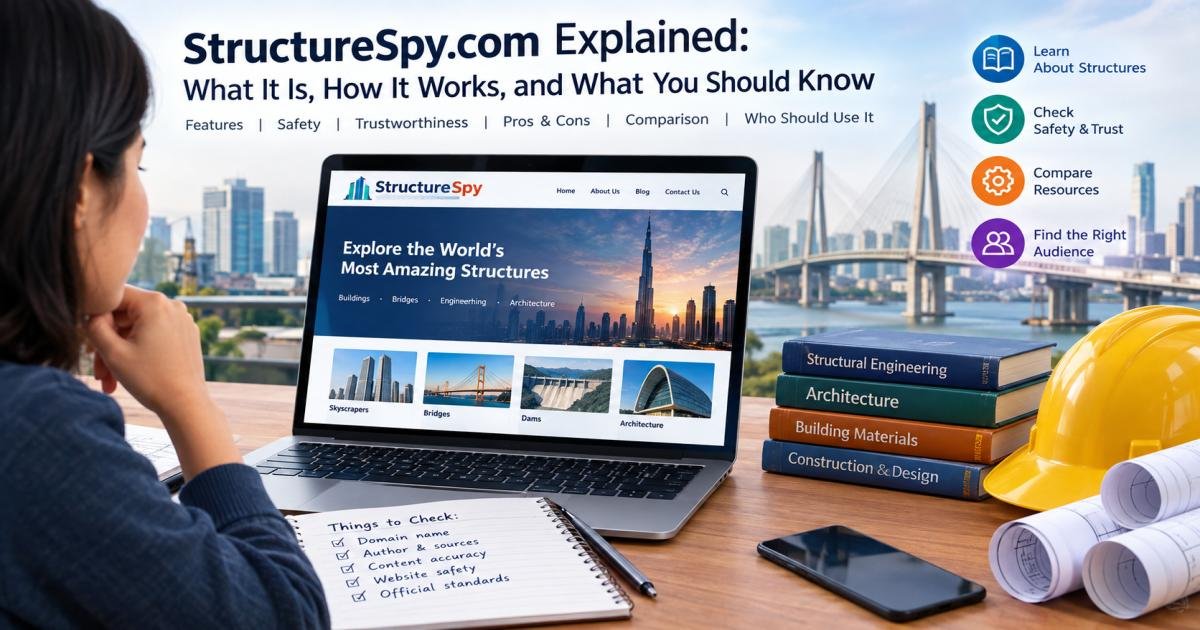

StructureSpy com is a WordPress blog that says it covers bridges, skyscrapers, stadiums, and industrial structures. It is not an engineering tool. On 12 October 2026, we counted 32 posts on its homepage. Only 12 covered a bridge, a stadium, or a power station. The rest were gaming guides, football bios, product promos, and reviews of other websites. The Skyscrapers section held no skyscraper posts at all.
So what is structurespy com in practice? It is a general blog that sells banner space, text links, and guest posts. Its pages carry roughly 85 outside links, most of them to betting and casino sites. A footer blurb claims “structural analysis services,” but we found no software, login, or calculator anywhere.
This structurespy.com review shows what the site is, how it earns money, and whether it is safe. It also tells you who can get value from it. Every point comes from pages we opened ourselves, one third-party scan, and three established engineering sites.
Quick facts
- What it is: a WordPress blog with four menu topics: Bridges, Industrial Structures, Skyscrapers, and Stadiums
- On-topic posts: 12 of 32 on the homepage, just over a third
- Software or calculators: none found
- How it earns money: banner slots, text links, and guest posts
- Author shown: “admin”
- Third-party scan: moderate risk, malware check clean
- Best use: casual reading, not technical decisions
How we checked: On 12 October 2026, we opened the homepage and the About, Contact, Disclaimer, and Write for Us pages. We also opened two posts, including one full engineering article. Then we compared our notes with a third-party site scan. Sites change, so recheck before you rely on any detail.
What Is StructureSpy.com?
StructureSpy.com is a public blog built on WordPress. Its menu lists four topics: Bridges, Industrial Structures, Skyscrapers, and Stadiums. The About page says the site exists to show famous buildings, bridges, dams, and stadiums to engineers, students, and curious readers.
The homepage tells a different story. Here is how the claims and the content compare:
| What the site says | What we found on 12 October 2026 |
| About page: a showcase of bridges, skyscrapers, dams, and stadiums | 12 of 32 homepage posts covered a structure. The Skyscrapers section had 0 of 8 |
| Menu label: Industrial Structures | 1 of 9 posts covered an industrial site. The rest included three gaming guides, a football jersey number, a garage door piece, and three business-structure pieces |
| Footer blurb: structural analysis services for builders | No login, calculator, upload form, or price list on any page we opened |
| Write for Us page: wants tech, gadgets, apps, AI, and gaming posts | Structural engineering is not on the topic list |
The mismatch shows up in every section. In Bridges, 5 of 9 posts dealt with bridge engineering. The other four were a dental crown article and three reviews of two other websites. In Skyscrapers, we saw a smartwatch promo, a football biography, and posts with Korean and Vietnamese titles. Only the Stadiums section stayed on topic, with six cricket venue posts.
This matters because some blogs describe StructureSpy com as an advanced analysis platform. The footer blurb is the likely source of that claim. Nothing else we saw backs it up.
How Does StructureSpy.com Work?
StructureSpy.com works like any WordPress blog, and it appears to earn money by selling placements. An admin account publishes posts, files each one under a category, and lets readers comment. That is the whole loop.
The money side is easy to spot. Pages across the site show “Rent your banner” slots, with a Gmail address and a WhatsApp number for buyers. The bottom of each page also shows contact details that appear aimed at buyers of text links. One address even uses the words “buy text links.”
The site also runs as a guest post website. Its Write for Us page asks for 800 to 1,500 words on tech news, gadget reviews, how-to guides, app roundups, AI, cybersecurity, and gaming. It offers an author bio with a backlink and promises a reply in 3 to 5 business days.
Paid placements are not unusual. They become a problem when a site hides them. Google tells site owners to mark ads and paid links with the sponsored value. We opened a review post about another website, and it carried no sponsored label. It linked to the reviewed site once, in the introduction. We could not tell whether that link carried a tag.
Typically, a blog that sells placements publishes what buyers want, not what its menu promises. That pattern fits what we saw: 20 of 32 homepage posts fell outside the structures theme.
For a reader, then, StructureSpy.com is a general reading site with a loose engineering theme, paid for by ads and links.
What Are the Main Features of StructureSpy.com?
Articles About Notable Structures
The on-topic StructureSpy.com articles focus on Indian bridges and cricket venues. One post covers the Wazirabad Signature Bridge. The Stadiums section has six posts. They cover a corporate box guide, boundary sizes for the Narendra Modi Stadium and the Mullanpur Stadium, and a pitch report for Sheikh Zayed Stadium. Two more list IPL 2023 records for the Rajiv Gandhi International Stadium and the HPCA Stadium.
Readers in India will know these names. Yet the titles point to match data, such as boundary sizes and records, more than to design or construction. If you want to know why a stadium roof stands up, these posts probably will not answer it.
Tip: Stadiums were the only category whose posts all matched their label in our check.
Engineering and Architecture Insights
The best posts are basic civil engineering explainers. We read the post on bridge expansion joints in full. It explains why bridges need joints, then covers five types: compression seal, modular, finger, sliding plate, and strip seal. Each type gets a short list of pros and cons. The language is plain, and the broad ideas are sound.
But the post is thin. The byline says “admin,” so no named author stands behind it. It lists no sources, no design codes, and no drawings. It gives one number: a movement range of 0.5 to 2 inches for compression seal joints. It says joints need inspection once or twice a year, with no source. The post is about a year old, and its counter showed 62 views. A civil engineer would call it a primer, not a reference.
Other posts use “structure” in a different sense. One covers the capital structure of a large Indian company. Another covers the structure of the tourism industry. Those are business topics, not buildings.
Educational Content for Students and Curious Readers
Posts use short sentences, and many end with a question-and-answer block. The expansion joint post has seven. That format suits a first read, and it explains each joint type in one short paragraph.
What the site lacks is practice material: no worked examples, no problems to solve, and no links to textbooks or standards. Use it for the gist. Then move to a textbook or a course.
Website Navigation and Reading Experience
The site runs on a ready-made WordPress theme. It has a top menu, category pages, a comment box, and a contact form that asks for a name, an email, and a message. Moving around is easy.
The labels cause the trouble. A Bridges post may turn out to be a review of another website. Expect ad blocks near the top of each page and a long block of outside links at the bottom.

Is StructureSpy.com Legitimate and Trustworthy?
StructureSpy.com is a real, working website. It is not a trustworthy source for technical facts. So, is structurespy.com legit? As a live blog, yes. As an engineering reference, no. The evidence answers those two questions differently.
What the Official Website Says About Its Purpose
The site describes itself three ways. The About page calls it a showcase of remarkable structures. The Write for Us page invites tech, gadget, app, and gaming posts. The footer blurb calls it a structural analysis service for builders. The posts match none of these fully.
Google’s guidance on helpful content asks site owners to be clear about who made a page and why. StructureSpy.com does not make either answer easy to find.
Checking Website Ownership and Contact Information
We found no company name, street address, or named editor. The Contact page offers a form. The footer lists a Gmail address and WhatsApp numbers. The post we read in full is credited to “admin.”
The About, Contact, and Disclaimer pages carry June 2025 publish dates. A third-party scan listed the domain’s age at about 1.3 years when it saved its review. On the Disclaimer page and the Write for Us page, the email link points to a different domain than the address shown on screen. That slip is typical of copied templates, and it does not build trust.
The same scan rated the site moderate risk and flagged it as suspicious. It said the site works like a link farm because of its many gambling and betting links. It found no scam complaints, and its malware check came back clean. We saw the outbound links ourselves, so that finding holds up.
Evaluating Content Accuracy and Editorial Transparency
A trustworthy post leaves marks you can check: a named author, a date, sources, a way to report errors, and a clear policy on ads. StructureSpy.com shows few of them. Google’s guidance asks for accurate bylines where readers expect them. On this site, the byline is “admin.”
Posts show a relative date such as “1 year ago” and no source list. We found no corrections page. The review post we opened carried no sponsored label. That matters, because a paid post can read like neutral advice.
What Readers Should Verify Before Trusting Its Information
Run any post through these five questions:
- Does the post name a real author you can look up?
- Does it cite a standard, a code, a paper, or an official report?
- Do its numbers match a second, stronger source?
- Is the post actually about the thing in its title?
- Could it be paid content with no label?
If you answer “no” to three or more, treat the post as a rough guide at best.
Is StructureSpy.com Safe to Visit?
Is structurespy.com safe? The pages we opened showed no sign of malware, and one third-party malware check came back clean. The risk sits in the links. By our count, the pages carry roughly 85 outbound links, most of them to casino and betting sites. The site’s own disclaimer says it cannot promise to be free of viruses or harmful components.
Potential Website Security and Privacy Concerns
Two lists hold the links. One is a block of about 40 casino and betting terms. The other is a “Useful links” list of about 45 more, many with Thai or Vietnamese link text. Some pairings look odd. Thai betting words point to a restaurant menu page and a museum site, for example. Mismatches like that typically signal paid link placement.
Rules on online betting differ by country and change often. Check your local law before you click any of those links.
On privacy, the comment form asks for a name, an email, and an optional website. The contact form asks for a name, an email, and a message. Share as little as you can.
How to Identify Suspicious Links, Ads, and Redirects
- Hover before you click. On a computer, the real address appears at the bottom of the browser. On a phone, press and hold the link.
- Match the words to the address. A link about bridges that opens a casino page is a red flag.
- Watch for extra tabs. A link that opens windows you did not ask for is a warning.
- Distrust urgency. Countdown timers, “you won” banners, and fake virus alerts are common tricks.
- Skip download prompts. If a page pushes you to install an app or file, close it.
Practical Safety Tips for First-Time Visitors
- Type the address yourself instead of following a link from a random page.
- Keep your browser and your phone or computer up to date.
- Turn on an ad blocker and your browser’s built-in warnings.
- Do not click anything in the footer.
- Do not enter passwords, phone numbers, or payment details.
- Never download files or apps from the site.
What to Do If You Encounter Unexpected Content
- Close the tab. If it will not close, close the whole browser.
- Do not enter any details or press “Allow” on notification requests.
- If you already allowed notifications, turn them off in your browser settings.
- Clear the site’s data from your browser and run a security scan.
- If you typed a password anywhere, change it right away.
- If you lost money, call your bank or payment provider at once.
What Are the Advantages and Limitations of StructureSpy.com?
Potential Benefits for Readers
- Free to read. We met no paywall or sign-in on any page we opened.
- Plain language. The expansion joint post explains five joint types without heavy jargon.
- Local interest. Posts cover the Wazirabad Signature Bridge and six cricket venues.
- Quick answers. Many posts end with short question-and-answer blocks. The joint post has seven.
Important Limitations
- No named authors or sources. The byline is “admin” on the post we read in full.
- Mixed topics. 20 of 32 homepage posts fell outside the structure’s theme.
- Misleading labels. The Skyscrapers section held 0 skyscraper posts out of 8.
- Outbound betting links. We counted roughly 85 on the pages we opened.
- Unclear ownership. There is no company name or address.
- Possible paid content. The site sells banner space and text links, and the review post we opened had no sponsored label.
- Not a tool. There are no calculators or software.
When to Consult Official Engineering Sources Instead
Use official sources whenever a decision depends on the facts. That covers exam answers, college projects, design work, repair choices, and anything about safety.
Here are examples. In India, the Indian Roads Congress sets codes for road bridges, such as IRC:6 for loads and IRC:112 for concrete bridges. The Bureau of Indian Standards publishes IS 456 for reinforced concrete. In the US, AASHTO publishes the LRFD Bridge Design Specifications. In Europe, the Eurocodes apply. The American Society of Civil Engineers and the Institution of Structural Engineers publish journals and guidance too.
StructureSpy.com vs. Similar Engineering and Architecture Websites
Comparing Content Focus and Learning Resources
| Site | Focus | Who runs it | Track record | Best for |
| structurespy com | Mixed blog with a structures theme | Not stated | Key pages dated June 2025; posts credited to “admin” | Casual reading |
| Structurae | Bridges, dams, towers, stadiums, and more | Created by a structural and bridge engineer | Online since 1998; more than 85,000 projects listed | Looking up real projects |
| CTBUH Skyscraper Center | Tall building data | The Council on Tall Buildings and Urban Habitat, a not-for-profit group | Launched in 2012 with a profile for every completed building over 200 meters | Skyscraper facts and rankings |
| SkyscraperPage | Skyscraper drawings, data, and a forum | Skyscraper Source Media, Victoria, Canada | Online since 1998 | Comparing building heights |
The other three name who runs them, and each has operated for more than a decade. StructureSpy.com names no one.
What to Look for in a Reliable Engineering Website
- A named person or organization behind it
- Sources, standards, or papers listed with the facts
- Dates and update notes on each page
- A legal page with real contact details
- A clear focus, with few unrelated posts
- Paid content that is clearly marked
Choosing the Right Resource for Your Needs
Want to look up a real bridge or tower? Try Structurae. Want the height or rank of a skyscraper? Try the CTBUH Skyscraper Center. Learning engineering for a course? Start with your textbook and your teacher’s notes, then add free university course material. Want a light read about bridges and cricket venues? StructureSpy.com can pass the time if you stay careful with clicks.
Who Should Use StructureSpy.com?
Students and Engineering Beginners
Use it as a warm-up for terms like “compression seal” or “modular joint.” Then confirm every fact in your textbook or a recognized course. Never cite it in an assignment or exam answer.
Architecture Enthusiasts and General Readers
If you enjoy posts about bridges or cricket stadiums, stay on the article pages and skip the footer and the ads. Treat each post as one opinion, not the last word.
Professionals Who Need Verified Technical Information
This site is not for you. Without named authors, sources, or code references, nothing here supports design, inspection, or safety work. Use standards, peer-reviewed papers, and your professional body’s guidance.
What Should You Know Before Using StructureSpy.com?
Verify the Exact Website Domain
Type structurespy.com yourself, and check the spelling letter by letter. Look-alike names are easy to mistake for the real one. Also remember that some blogs call it a software platform. The live site does not match that description.
Distinguish Educational Articles From Professional Engineering Tools
StructureSpy.com is a set of articles. It is not a calculator, a design package, or a monitoring service. If anyone offers you structural analysis “from StructureSpy,” asks for your project data, or asks for payment in advance, stop. We saw no sign of such a service on the site.
Cross-Check Important Claims With Authoritative Sources
When a post gives a figure, a rule, or a safety claim, find a stronger source. For example, the expansion joint post says compression seal joints suit movements of 0.5 to 2 inches. Before you use that number, check it in a highway agency bridge manual or a manufacturer data sheet. If you cannot confirm a claim, do not use it.
Final Verdict
Only lightly. StructureSpy.com is a real blog with a few readable basics on bridges and a set of cricket stadium posts. But only 12 of 32 homepage posts covered a structure, and the Skyscrapers section had none. The site names no owner and credits its posts to “admin.” It sells ad space, links, and guest posts. Its pages carry roughly 85 outside links, most of them to betting sites. A third-party scan rated it moderate risk, though its malware check came back clean.
If you want to learn about structures, you have better options. Structurae, the CTBUH Skyscraper Center, and SkyscraperPage all show who runs them and where their data comes from. If you do visit structurespy com, read the article you came for, skip the footer, and check every important fact somewhere stronger.
FAQs
What Is structurespy com?
StructureSpy.com is a WordPress blog that says it covers bridges, skyscrapers, stadiums, and industrial structures. On 12 October 2026, 12 of its 32 homepage posts covered a structure. The site also sells banner space, text links, and guest posts. It is a website, not engineering software.
What Is StructureSpy.com Used For?
Readers use StructureSpy.com for light reading about Indian bridges, cricket stadiums, and basic civil engineering ideas. The site owner appears to use it to sell banner space, text links, and guest posts. Nobody can use it for structural analysis, design, or monitoring, because it offers no tools.
Is StructureSpy.com Free to Access?
Yes. We met no paywall, login, or fee on any page we opened. The site seems to earn money from banner slots, text links, and guest posts, not from readers. You pay in attention instead, since ad blocks and outside links fill the page edges.
Is StructureSpy.com a Website or an Engineering Tool?
It is a website. We found no calculator, software download, login, or upload form on any page we opened. A footer blurb claims structural analysis services for builders, but nothing on the site backs that claim. Treat any offer of StructureSpy analysis as unverified.
Can Engineering Students Learn From StructureSpy.com?
Beginners can pick up basic ideas, such as the five types of bridge expansion joints. But the site names no authors, lists no sources, and offers no practice problems. Use it as a warm-up, then confirm everything in your textbook, course notes, or a design code.
Is StructureSpy.com Safe to Use?
The pages we opened showed no sign of malware, and one third-party malware check came back clean. The same scan rated the site moderate risk because of its many betting links. Browse with care, skip the footer, and never enter passwords or payment details.
How Can I Verify Whether StructureSpy.com Is Reliable?
Run four checks. Look for a named author, cited sources, a named owner, and a second trusted source that confirms the claim. StructureSpy.com fails the first three on the pages we checked. For safety, scan the address with a reputable website checker before you click through.
Does StructureSpy.com Accept Guest Posts?
Yes. Its Write for Us page asks for 800 to 1,500 words on tech news, gadgets, apps, AI, cybersecurity, and gaming. Writers get an author bio with a backlink. The page promises a reply within 3 to 5 business days. Structural engineering is not on the topic list.
Who Runs StructureSpy.com?
The site does not say. We found no company name, street address, or named editor. Posts carry the byline “admin,” and contact options are a form, a Gmail address, and WhatsApp numbers. A third-party scan listed the domain as about 1.3 years old.