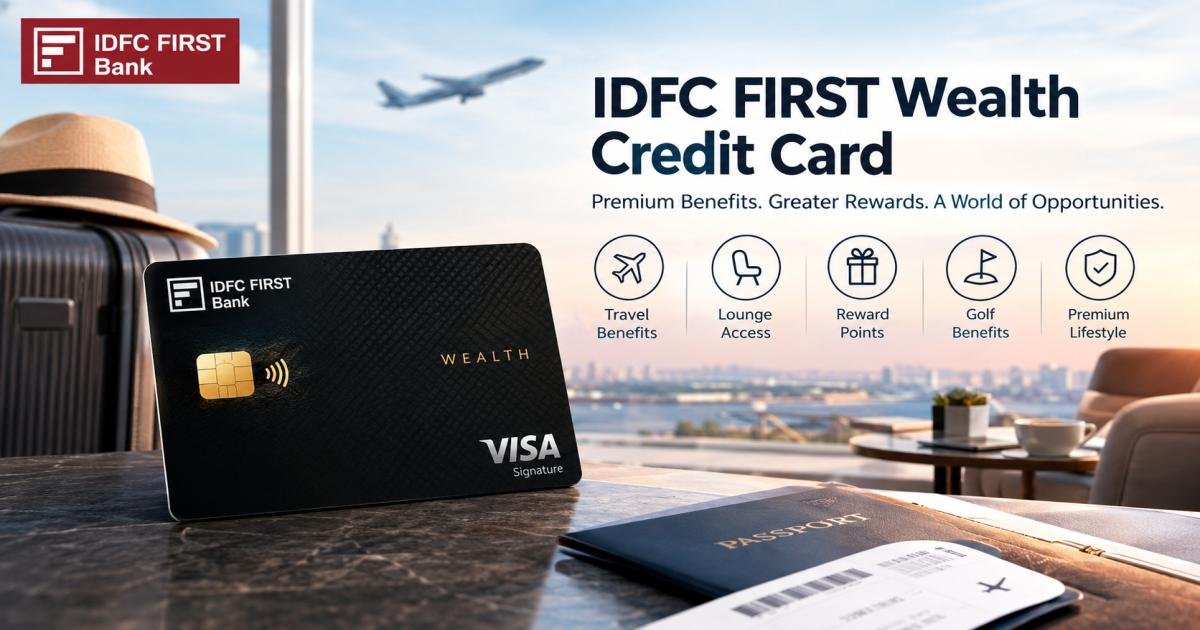

The IDFC FIRST Wealth Credit Card is a lifetime-free premium credit card from IDFC FIRST Bank that gives high-income earners airport lounge access, golf privileges, a low forex markup, and a tiered reward points system, without charging any joining or annual fee. It is built for people who earn well, travel a few times a year, and want premium perks without a yearly bill attached to the card.
That one paragraph answers what most people want to know first. But a credit card is a long-term financial tool, not a one-line pitch, so this guide breaks down what you actually get, what it costs you in effort and spending discipline, and who the IDFC FIRST Wealth Credit Card really fits.
If you looked up this card, you are probably weighing one of three questions: do you qualify for it, are the rewards worth chasing, or would a paid premium card serve you better? This guide works through all three, using the card’s current 2026 terms rather than older figures still circulating on comparison sites.
What This Guide Covers
This article walks through the full IDFC FIRST Wealth Credit Card benefits list, how the reward point system works after the January and April 2026 revisions, the real fee structure, who qualifies, how to apply, and how the card stacks up against other premium options in India. It also covers the golf and lounge benefits in detail, since those two perks generate the most confusion once people actually start using the card.
By the end, you should know whether this card fits your income, spending pattern, and travel habits, or whether a different card would put more money back in your pocket.
What Is IDFC FIRST Wealth Credit Card?
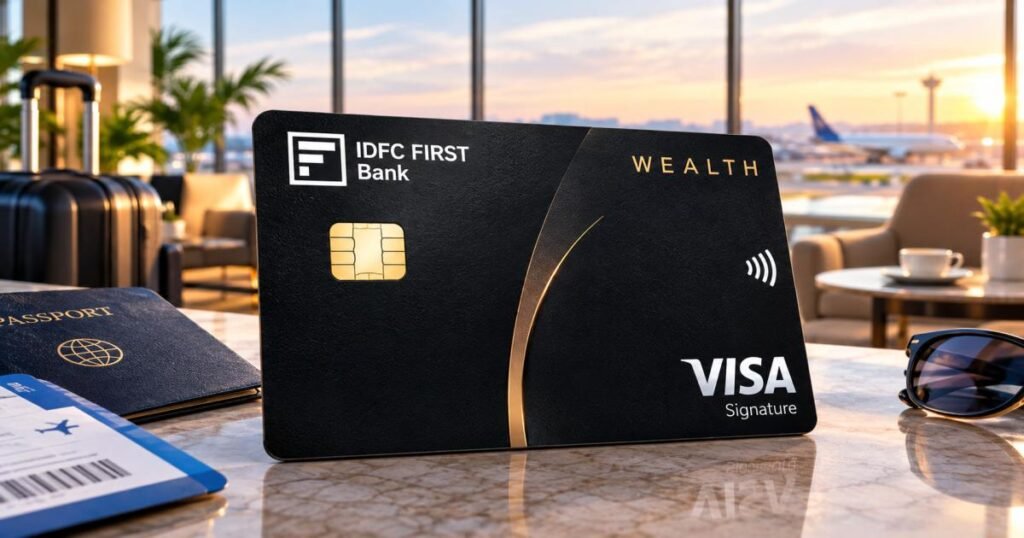
The IDFC FIRST Wealth Credit Card is a Visa Infinite metal credit card issued by IDFC FIRST Bank, aimed at high-net-worth and high-income individuals in India. It sits at the top of the bank’s personal credit card lineup, above entry and mid-tier cards like FIRST Select and FIRST Classic.
What separates it from most cards in this category is the fee structure. Premium cards typically charge an annual fee of ₹5,000 to ₹15,000 or more, waived only once you cross a set spending threshold each year. The IDFC FIRST Wealth Credit Card charges nothing at all, for life, whether you spend heavily or barely touch the card.
In exchange, the bank sets a high income bar for approval, and it links several of the card’s best perks, including lounge access and golf rounds, to a minimum monthly spend rather than handing them out unconditionally. Understanding that trade-off- free access up front against conditional perks later- matters more than any single benefit on the list.
IDFC FIRST Wealth Credit Card at a Glance
Here is a quick summary before we go section by section.
| Feature | Details |
| Card network | Visa Infinite (RuPay variant also available) |
| Joining fee | ₹0 |
| Annual fee | ₹0 (lifetime free) |
| Minimum income | ₹36 lakh per year, or roughly ₹3 lakh net monthly income |
| Reward rate | 3X on regular spends, 10X on dining, travel, international, and birthday spends |
| Forex markup | 1.5% + GST |
| Lounge access | 1 domestic and 1 international visit per quarter, spend-linked (as of April 2026) |
| Golf | Complimentary rounds, spend-linked |
| Interest rate | 0.75% to 2.99% per month |
| Age requirement | 21 to 65 years |
Keep this table as a reference point. Every row is explained in the sections below.
IDFC FIRST Wealth Credit Card Benefits
What does the IDFC FIRST Wealth Credit Card actually offer beyond the zero-fee headline? The card bundles travel perks, everyday reward points, and lifestyle extras into one package. Here is a breakdown of what matters most.
Lifetime-Free Credit Card
There is no joining fee and no annual fee, ever. Most premium cards ask you to spend a set amount each year just to get the annual fee waived. This card removes that requirement outright. You keep every core benefit whether you spend ₹10,000 or ₹10 lakh in a year, though the reward rate and lounge access you actually unlock still depend on your monthly spending pattern, covered in detail below.
Reward Points on Everyday Spending
You earn reward points across nearly every spending category, split into tiers based on transaction type and monthly spend level. Fuel, most insurance premiums, EMI conversions beyond the first transaction, and cash withdrawals do not earn points, so do not expect a return on those specific transactions.
Airport Lounge Access
Cardholders get access to domestic airport lounges across India through the bank’s lounge program. As of April 2026, this benefit was reduced from four visits per quarter to one visit per quarter, and it activates only if you spent ₹20,000 or more in the previous month. This is a real change from earlier years, so do not assume frequent or unconditional lounge visits without checking last month’s spend first.
International Lounge Access
The card also includes access to select international airport lounges, again capped at one visit per quarter under the April 2026 revision and tied to the same ₹20,000 prior-month spending condition. Does that mean international lounge access is guaranteed on every trip? No. If you travel abroad often and want dependable lounge access, this card alone will not be enough, and pairing it with a dedicated lounge membership is worth considering.
Travel and Hotel Benefits
Beyond lounges, the card includes complimentary travel insurance when you book tickets on it, covering baggage loss or delay up to roughly USD 1,200, and cancellation compensation up to ₹10,000 for flight or train disruptions. There is also basic emergency medical support while traveling overseas, discounted airport immigration services at over 450 destinations, discounted limousine transfers in more than 3,000 cities, and access to 900-plus luxury hotels worldwide through partner programs. Roadside assistance worth ₹1,399 is available up to four times a year within India.
IDFC FIRST Wealth Credit Card Rewards Explained
How do IDFC FIRST Wealth Credit Card reward points actually work? The rewards program is the part most applicants care about, and it changed twice in 2026, so the figures below reflect the current structure rather than older numbers still floating around online.
How Many Reward Points Can You Earn?
Since January 18, 2026, the earning base shifted from ₹150 to ₹200 spent per reward point, which works out to roughly a 25% cut in point value compared to the earlier structure. Points are also conditional now: miss the minimum payment due date in a billing cycle, and you earn zero points for that cycle, with any points already credited getting reversed. On-time payment now directly protects your reward accrual, not just your credit score.
10X Reward Points on Eligible Dining and Travel Spending
You earn 10 reward points per ₹200 spent on dining, travel, and international transactions, plus all spending on your birthday, with a few category exclusions like rent, insurance, and utilities. This tier returns roughly 1.25% in value on eligible categories, a solid rate for a fee-free card but still below what several paid premium cards offer on comparable spending.
3X Reward Points on Other Eligible Transactions
Regular offline and online purchases up to ₹20,000 in a statement cycle earn 3 points per ₹200 spent. Cross that ₹20,000 mark in a month, and your incremental spending shifts into the accelerated 10X tier. Below the threshold, the effective return sits around 0.75%, a rate several 2026 reviews flag as weak compared to competing cards in this income bracket.
1X Reward Points on Select Categories
Utility bill payments, insurance premiums, rental payments, education fees, wallet loads, and government service payments earn 1 point per ₹200 spent. As of January 2026, FASTag and railway spends were also folded into this lower 1X tier, a downgrade from how they were classified previously.
20% Bonus Travel Rewards Through the IDFC FIRST App
Booking flights and hotels directly through the IDFC FIRST Bank mobile app currently unlocks bonus reward points on top of the standard rate, reported around 13% extra on flight bookings and 33% extra on hotel bookings in recent bank communications. These promotional rates change from time to time, so confirm the exact figure inside the app before you book rather than relying on numbers quoted here or elsewhere.
IDFC FIRST Wealth Credit Card fees
Does a lifetime-free card really have zero charges attached to it? Mostly, but not entirely. A few costs still apply, and knowing them ahead of time helps you avoid surprises on your statement.
- Joining and annual fee: ₹0, for life
- Interest rate: 0.75% to 2.99% per month on revolving balances, depending on your risk profile
- Forex markup: 1.5% plus GST on international transactions, notably lower than the 3% to 3.5% many other Indian cards charge
- Cash withdrawal: Interest-free for up to 48 days if paid in full, though a cash advance fee typically applies at the time of withdrawal
- Utility bill payment charge: A 1% transaction charge applies on utility bill payments exceeding ₹20,000 in a single billing cycle
- RuPay variant fee: A separate RuPay version of the card, built for UPI-linked spending, carries an annual fee of ₹199, unlike the fee-free Visa version
Always check the card’s latest Most Important Terms and Conditions (MITC) document on the bank’s website, since fee structures on Indian credit cards typically get revised every year or two.
IDFC FIRST Wealth Credit Card Eligibility
Who qualifies for the IDFC FIRST Wealth Credit Card? The card sits in a high-income bracket, and its eligibility criteria reflect that directly.
Minimum Income Requirement
Applicants generally need an annual income of ₹36 lakh, or a net monthly income of around ₹3 lakh, whether salaried or self-employed. Some third-party comparison sites list a slightly lower unofficial threshold used for pre-approval marketing offers, but the bank’s own published requirement is the figure worth planning around.
Age and Other Basic Requirements
You must be between 21 and 65 years old to apply. You also need to be an Indian resident and provide standard KYC documentation as part of the process.
Existing IDFC FIRST Bank Customers
If you already bank with IDFC FIRST, particularly through a savings account, fixed deposit, or another credit card, the bank often has more visibility into your income and repayment history already on file. This can speed up approval and, in some cases, support a pre-approved offer, though it does not waive the income requirement itself.
Credit Score and Approval Considerations
A credit score of 750 or above is typically recommended to improve approval odds for a premium card in this bracket. A clean repayment history, free of defaults or delayed payments on existing loans or cards, matters just as much as the score itself. Given the strict income bar, approval leans heavily on verified income proof and credit history rather than the score alone.
Documents Required for IDFC FIRST Wealth Credit Card
What documents do you need before applying? Keep these ready in advance:
- Identity proof: PAN card (mandatory), along with Aadhaar, Voter ID, Passport, or Driving Licence
- Address proof: Aadhaar, Passport, Voter ID, Driving Licence, or a recent utility bill or rental agreement if your ID shows an outdated address
- Income proof (salaried): Latest three months’ salary slips and recent bank statements
- Income proof (self-employed): Latest audited Income Tax Return (ITR) or Form 16, along with business bank statements
- Photograph: A recent passport-size photo, for offline or branch applications
How to Apply for the IDFC FIRST Wealth Credit Card
How does the application process actually work from start to finish? You can apply online, through the mobile app, or by visiting a branch in person.
Online Application Process
Visit the IDFC FIRST Bank website and find the Wealth Credit Card page under the Cards section. Click “Apply Now,” then enter your name exactly as it appears on your Aadhaar card, your date of birth, and a 10-digit mobile number. An OTP verifies your number, after which you fill in your PAN, income details, and employment information.
Verification and Documentation
Once your basic details are submitted, upload your identity, address, and income documents. Most applicants also complete a video KYC step directly from their phone, which the bank uses to verify identity in real time. If you already have an IDFC FIRST net banking login, using it during the application can sometimes speed up verification, since the bank already holds part of your data on file.
Approval and Card Delivery
If your profile meets the eligibility bar, many applicants get instant digital approval, subject to final verification. Physical card delivery typically takes three to seven working days after approval. Once it arrives, activate it through the mobile app, internet banking, or the 24×7 customer care line, and generate your 4-digit PIN before your first ATM or POS transaction. Indian regulations require activation within 30 days of issuance, or the account may be closed automatically.
IDFC FIRST Wealth Credit Card Lounge Access Explained
Is lounge access on this card automatic, or does it depend on how you use the card? It depends, and this is one of the most misunderstood parts of the IDFC FIRST Wealth Credit Card. To unlock a lounge visit in the current quarter, you need to have spent ₹20,000 or more on the card in the previous month. As of April 2026, the benefit itself was also reduced to one domestic and one international visit per quarter, down from four each.
In practice, this means occasional users who do not consistently cross the ₹20,000 monthly spend threshold can end up without lounge access exactly when they need it, such as before an unplanned trip. If lounge access is your main reason for wanting this card, track your monthly spend closely, or pair the card with a dedicated lounge access program.
IDFC FIRST Wealth Credit Card Golf Benefits
The card includes complimentary golf privileges at select courses, positioned alongside spa access as part of its lifestyle bundle. Like lounge access, golf benefits are typically linked to a minimum spend threshold, and the number of complimentary rounds available can vary by billing cycle and by course partnership. If golf access is a deciding factor for you, check the current list of empanelled golf courses and the exact spend condition on the bank’s official card page before applying, since course tie-ups change over time.
IDFC FIRST Wealth Credit Card Travel Benefits
Beyond lounges and golf, the travel benefit package includes a notably low forex markup of 1.5% plus GST, roughly half of what many other Indian credit cards charge on international spending. You also get complimentary travel insurance covering baggage loss, baggage delay, and trip cancellation, plus discounted airport meet-and-greet and immigration services at hundreds of destinations worldwide. For someone who travels a few times a year internationally but does not want a dedicated, fee-charging travel card, this combination delivers real, measurable savings on every foreign transaction.
IDFC FIRST Wealth Credit Card Pros and Cons
Pros
- No joining fee or annual fee, for life
- Low 1.5% forex markup on international spending
- Reward points never expire
- Complimentary travel insurance and roadside assistance
- Domestic and international lounge access, though now spend-linked
- Golf privileges as part of its lifestyle bundle
- Metal card design with Visa Infinite positioning
Cons
- High income requirement of ₹36 lakh annually limits who can apply
- Base reward rate of 0.75% below ₹20,000 monthly spend trails several competing cards
- Lounge and golf access both require ₹20,000 spend in the preceding month
- Lounge visits were cut from four to one per quarter in April 2026
- Reward points are forfeited entirely if you miss a minimum payment due date
- FASTag and railway spends now earn only the lowest 1X tier
Who Should Get the IDFC FIRST Wealth Credit Card?
Who actually benefits most from this card? People who already meet the ₹36 lakh income bar and want premium features without paying an annual fee sit at the center of its target audience. It particularly suits salaried professionals or business owners who travel a few times a year internationally, consistently spend above ₹20,000 a month on the card, and value a low forex markup more than an aggressive rewards rate. If you dislike paying annual fees on principle, even when a fee-based card might return more value overall, this card removes that friction completely.
Who Should Avoid the IDFC FIRST Wealth Credit Card?
When does this card stop making sense? If your monthly spend regularly falls below ₹20,000, you miss the card’s best perks, including lounge access and the accelerated reward rate, while still holding a card with a fairly average 0.75% base return. Frequent flyers who want dependable, unconditional lounge access every month, without tracking a spending threshold, are usually better served by a paid premium travel card. Similarly, if you fall short of the ₹36 lakh income requirement, a mid-tier IDFC FIRST card like Select or Classic is a more realistic starting point.
IDFC FIRST Wealth Credit Card vs Other Premium Credit Cards
How does the IDFC FIRST Wealth Credit Card compare with other premium cards in India?
| Card | Annual Fee | Reward Rate | Lounge Access | Forex Markup |
| IDFC FIRST Wealth | ₹0 (lifetime free) | 0.75% to 1.25% | Spend-linked, 1/quarter | 1.5% + GST |
| HDFC Regalia Gold | Fee-based, spend-waivable | Around 1% to 2% | Higher visit allowance | Around 2% |
| HDFC Diners Club Black | High fee, spend-waivable | Among the highest in India | Unlimited domestic and international | Around 2% |
| SBI Card Elite | Fee-based, spend-waivable | Moderate to high | Higher visit allowance | Around 3% |
The pattern is consistent across the category: cards that charge an annual fee typically offer stronger reward rates and more generous, less conditional lounge access. The IDFC FIRST Wealth Credit Card trades some of that value for the simplicity of never paying a fee, which works well for cautious spenders but leaves value on the table for people who spend heavily every month and could offset a paid card’s fee with ease.
How to Maximize the IDFC FIRST Wealth Credit Card Benefits
How can you get the most value out of this card once you have it? Track your spending against the ₹20,000 monthly threshold deliberately, since crossing it unlocks lounge access, golf privileges, and a better effective reward rate for the following month. Route dining, travel, and international purchases through this card specifically, since they sit in the 10X tier, while moving smaller everyday purchases to a card with a better base rate if you own one. Book flights and hotels through the IDFC FIRST Bank app rather than third-party sites when bonus reward campaigns are active, and always pay at least the minimum amount due on time, since a missed payment wipes out that entire cycle’s points. Redeem points periodically instead of letting them sit unused, and use the BOGO movie ticket offer through the District app if you attend movies regularly, since it can add up to meaningful savings over a year with almost no extra effort.
Important Changes to the IDFC FIRST Wealth Credit Card in 2026
What actually changed on this card in 2026, and why does it matter? Two rounds of revisions reshaped the card’s value this year, and both matter if you are comparing it against older reviews still circulating online. In January 2026, the reward-earning base moved from ₹150 to ₹200 spent per point, an across-the-board devaluation of roughly 25% on point accrual, and FASTag and railway spends were downgraded to the lowest 1X earning tier. Reward points also became conditional on timely payment starting this cycle, so a missed due date now costs you the entire cycle’s points, not just a late fee. Then in April 2026, lounge access was cut from four visits per quarter to one, for both domestic and international lounges, while keeping the same ₹20,000 prior-month spend condition attached. Golf and spa benefits, along with the 1.5% forex markup, stayed unchanged through both revisions. If you are relying on an older article’s numbers, treat lounge visit counts and reward rates as outdated unless the source is explicitly dated after April 2026.
Is the IDFC FIRST Wealth Credit Card Worth It?
Is the IDFC FIRST Wealth Credit Card actually worth applying for in 2026? For someone who meets the income requirement, spends consistently above ₹20,000 a month, and travels a few times a year internationally, yes, the card earns its place mainly through the combination of zero fees and a genuinely low forex markup. For someone whose spending is inconsistent, or who expected the generous four-visits-per-quarter lounge access that older reviews describe, the card looks noticeably less appealing after the 2026 devaluations. The honest answer depends less on the card itself and more on whether your spending pattern lines up with the thresholds it requires.
Final Verdict
The IDFC FIRST Wealth Credit Card remains one of the few genuinely fee-free premium cards in India, and that alone makes it worth considering if you meet the eligibility bar. But “lifetime free” does not mean the card comes with no conditions attached. Nearly every valuable perk, from lounge access to golf to the accelerated reward rate, depends on hitting a ₹20,000 monthly spend, and the 2026 changes made the card noticeably less generous than it was a year earlier. Go in with realistic expectations: treat it as a solid no-cost travel companion for consistent spenders, not as a replacement for a dedicated high-value premium card if your spending or travel habits run heavier than average.
FAQs
Is IDFC FIRST Wealth Credit Card lifetime free?
Yes. The card has no joining fee and no annual fee for as long as you hold it, regardless of how much you spend each year.
What is the value of 1 IDFC FIRST reward point?
Reward point value varies by redemption method, but based on the current earning structure, the effective return works out to roughly 0.75% on regular spends and up to about 1.25% on accelerated categories like dining, travel, and birthday spends.
Does the card offer international lounge access?
Yes, but as of April 2026, it is limited to one visit per quarter and requires a minimum spend of ₹20,000 in the previous month to activate.
Does IDFC FIRST Wealth Credit Card have a forex markup?
Yes, but it is low compared to most Indian credit cards, at 1.5% plus GST on international transactions, versus the 3% to 3.5% many other cards charge.
Does the card offer complimentary golf access?
Yes, the card includes complimentary golf rounds at select courses as part of its lifestyle benefits, generally linked to meeting a minimum monthly spend condition.
How can I apply for the IDFC FIRST Wealth Credit Card?
You can apply online through the IDFC FIRST Bank website or mobile app, or in person at a branch. The process involves entering your basic details, uploading identity, address, and income documents, and completing a video KYC step for verification.
Is the IDFC FIRST Wealth Credit Card worth it in 2026?
It is worth it for high earners who consistently spend above ₹20,000 a month and want a fee-free card with low forex charges and reasonable travel perks. It is less compelling after the 2026 devaluations for occasional spenders who expected the more generous lounge access the card offered in previous years.