
To serpinsight buy backlinks, create a free account on serpinsight.com, browse its publisher marketplace, filter sites by niche, traffic, and authority, pick a guest post or link insertion, submit your target URL and anchor text, pay from your wallet, and confirm the live link. Setup takes minutes. Delivery time depends on the publisher.
Know the main risk before you spend anything. Google’s spam policies treat paid links that pass ranking credit as link spam. This guide covers the steps and that risk together, so you can decide with the full picture.
It is built on documents, not hype: SERPInsight’s service pages, Terms of Service, Refund Policy and Delivery Policy, plus Google’s spam policies (last updated 28 August 2026). No order was placed for this guide, so it contains no invented results. It follows one rule throughout, the Terms-first rule: read the contract before the homepage. SERPInsight’s own Terms say the Terms govern and that public website descriptions are illustrative only.
What is SERPInsight and How Does Its Backlink Marketplace Work?
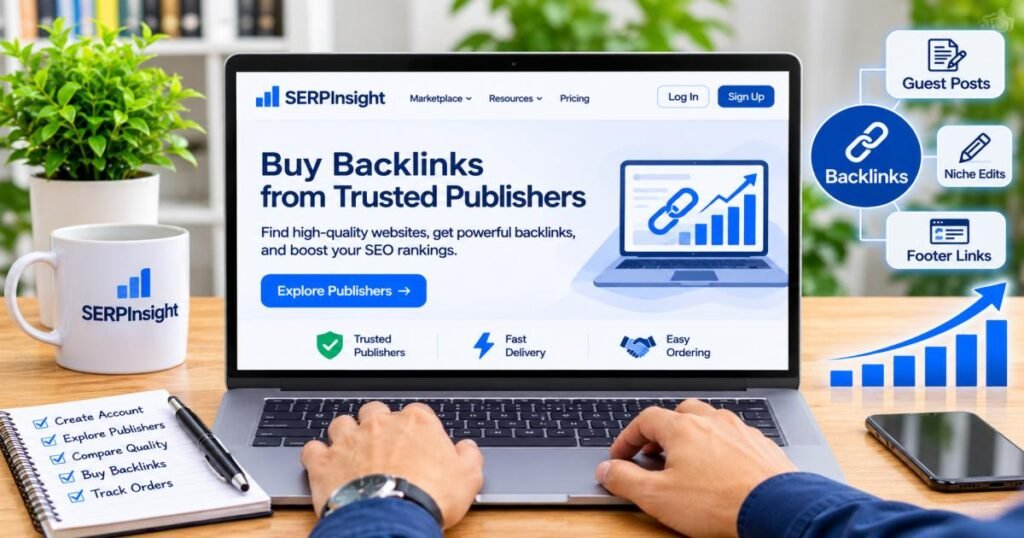
SERPInsight is a self-serve marketplace where you pay independent websites to publish your link. It sells guest posts, niche edits, and footer links, and it says it lists more than 5,000 publishers.
The company behind it, SERPInsight LTD, calls itself an intermediary only. It does not own, edit,t or publish the listed sites, so your deal for each placement is with the publisher. That is why every publisher sets its own price, content rules, es and turnaround time, and why each one can accept or reject your request before work starts. An order is a request, not a guaranteed link.
How does SERPInsight vet its sites? According to its homepage, each one passes an automated check using Ahrefs and Moz data, then a manual review of traffic, authority, content quality, and legitimacy. Treat that as the platform’s claim. The Terms add that metrics come from third-party tools and may be delayed or wrong, so verify the numbers that matter to you.
How does it charge? Signing up is free, and there is no subscription. You top up a wallet and pay per order. The Terms say the platform may add a fee, typically 5% to 10% of the order value, and the checkout page shows it before you confirm.
Why Do Link Builders and Search Marketers Use SERPInsight to Buy Backlinks?
They use it to save time. Finding sites, digging up contacts, pitching,g and following up can typically take days or weeks for a single link. A marketplace turns that into a search page and a filter panel.
People who buy backlinks to improve search rankings usually want a faster route to relevant publishers. Three features explain most of the appeal. Visibility comes first: price, delivery time,e and metrics such as Domain Rating (DR), Domain Authority (DA), and monthly traffic appear before you commit. Pay-per-order pricing comes second, so a freelancer or small business can test one placement without a monthly plan. One dashboard for many clients comes third, which suits agencies. The homepage names freelancers, agencies, SaaS companies, e-commerce brands, affiliate marketers,s and startups as its audience.
Here is a simple example (illustrative, not a real customer). A small bookkeeping firm wants one link from a finance blog. Doing outreach by hand might mean ten emails and a week of waiting. On a marketplace, the firm filters for finance, reads three listings,ngs and submits an order in one sitting. The time saved is real. The ranking benefit is not promised.
That last point matters. SERPInsight’s Terms say it does not guarantee rankings, traffic, or indexing. A marketplace speeds up buying. It does not decide whether a link helps.
What Types of Backlinks Can You Buy on SERPInsight?
SERPInsight sells three placement types: guest posts, niche edits, and footer links.
Guest posts: A publisher posts a brand-new article with your link inside. You can upload your own draft or send a brief, and most publishers accept either. You control the topic and where the link sits.
Niche edits: Also called link insertions, these add your link to an article that is already published and indexed. The platform says they are usually faster and cheaper than a full guest post. The trade-off is less control over the words around your link.
Footer links: These are sitewide or footer placements, pitched for brand visibility and steady referral traffic. Treat them with care. Google’s spam policies list widely distributed footer links as an example of link spam, so beginners usually do better with guest posts or niche edits.
How to SERPInsight Buy Backlinks: Step-by-Step Process
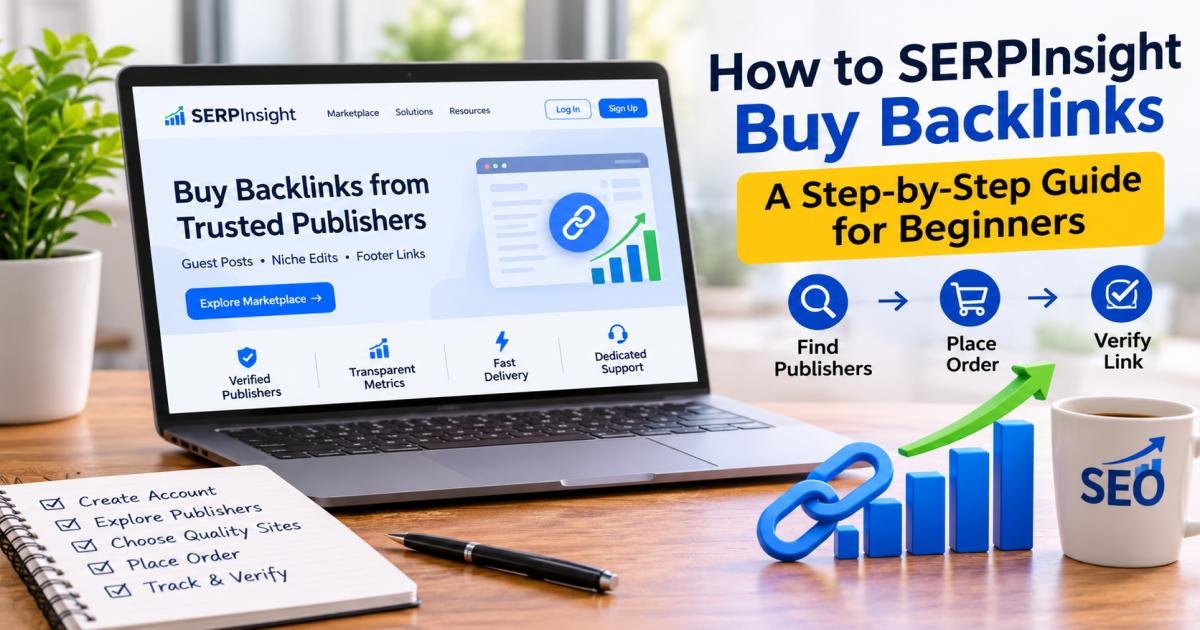
Ordering takes ten steps. Here is the short version, then the details for each one.
- Create a free account.
- Browse the publisher marketplace.
- Filter by niche, traffic,c and authority.
- Compare publisher quality and price.
- Choose a guest post or niche edit.
- Enter your target URL and anchor text.
- Add your article or brief.
- Review the order and pay from your wallet.
- Track the order in your dashboard.
- Verify the live link within seven days.
Button labels may change as SERPInsight updates its dashboard. The order flow itself follows the platform’s published policies.
Step 1: Visit SERPInsight and Create an Account
Go to serpinsight.com and click Start Free. You must be at least 18, and the details you enter must be accurate. Use an email address you check daily, because publisher and support messages arrive there. The Terms make you responsible for all activity on your account, so pick a strong password and keep it private.
Read the Terms of Service and the Refund Policy now, before you add money. They are short enough for one sitting, and they answer most “what if” questions. Then fund your wallet with a small amount. Top-ups are prepaid platform credits, and the Terms say they may not be refundable to your original payment method.
Step 2: Explore the Available Publisher Websites
Open the marketplace from the top menu. Each listing shows the site’s metrics, price, delivery estimate, and basic rules. Spend your first session just looking.
One caution: the sample table on SERPInsight’s homepage is labelled as example listings, not real sites. Judge the live listings inside the marketplace instead of the homepage preview.
Step 3: Filter Websites by Niche, Traffic, and Authority
SERPInsight advertises more than 20 filters, including DR, DA, traffic, niche, country, language, price, and delivery speed. Apply them in a sensible order: niche first, then country and language, then a traffic floor, and authority last.
Why that order? A site with moderate authority that covers your topic and reaches your audience usually serves you better than a high-DR site that publishes about everything. In the bookkeeping example, the firm filters for finance, picks its target market, sets a modest traffic floor, and only then looks at DR. Authority scores are third-party estimates, not ranking promises.
Step 4: Compare Publisher Quality and Pricing
Shortlist three to five publishers and open each site in its own tab. Read a few articles. Look for real author names, recent posts, a clear topic focus,s and a normal amount of advertising. A site that looks abandoned, or that runs casino, loan,n and supplement posts side by side, makes a poor home for your link.
Then compare price, turnaround, and content rules. If you want to buy backlinks cheaply, choose smaller niche sites with real readers rather than the lowest price on the page. Very low prices often point to thin sites that exist mainly to sell links.
Step 5: Select a Suitable Backlink Placement
Pick the placement that matches your goal. Choose a guest post when you want fresh, topic-focused content on a strong site. Choose a niche edit when you need a faster link on a relevant page that already exists. The platform notes that many campaigns use both over time.
Keep the first order small: one or two links. Judge the result, the publisher’s speed, and the process before you scale up.
Step 6: Submit Your Target URL and Anchor Text
Choose the page you want to promote. It does not have to be your homepage, and a useful guide or resource page often earns a more natural link.
Next, pick your anchor text, the clickable words. Mix them up. The bookkeeping firm might use its brand name (say, Ledger & Co, an invented example), the bare URL, and a descriptive phrase such as small-business bookkeeping checklist. Repeating the same exact-match keyword every time looks forced, and Google’s spam policies single out optimized anchor text in guest posts as a problem pattern. Check your spelling before you submit, because the Refund Policy says remedies may be limited once an order is complete.
Step 7: Provide Your Article or Content Requirements
For a guest post, upload a finished article or send a brief. Requirements vary by publisher and appear before you order, so read them: word count, format, number of links,s and allowed topics. Some publishers may also offer to write the piece for you. If yours does, read the draft carefully before you approve it.
Write for the publisher’s readers, not for the link. A useful, original article with sources and one relevant link has a better chance of being accepted and staying live. By submitting, you also confirm that you have the right to use the content and URLs you provide.
Step 8: Review and Place Your Backlink Order
Before you pay, check the target URL, anchor text, publisher, price, platform fee, and delivery estimate. Then confirm the order.
Your payment comes from your wallet and may sit in an escrow-style hold. Here the Terms-first rule pays off. The Terms say this is not a regulated escrow account, and that funds can be released to the publisher once the platform confirms placement, which is not the same as you being satisfied. The publisher can still reject your request. If that happens, eligible funds are normally credited back to your wallet.
Step 9: Track Your Order Through the Dashboard
Use the dashboard to follow progress. The usual path is simple: the publisher reviews your request, accepts it, publishes or inserts the link, and submits the live URL for platform review.
The turnaround time on each listing is an estimate, not a promise. The homepage says most placements go live within an hour to a few hours, but a slow publisher can take longer. If a publisher misses the stated window, the Refund Policy says wallet credit may be issued, and you can reorder elsewhere. Answer publisher or support questions quickly so your order does not stall.
Step 10: Verify Your Published Backlink
Do not rely on the platform check alone. SERPInsight’s Delivery Policy says its review confirms only that the link looked live at that moment. It does not mean the page is indexed or that the link will last.
Open the live URL yourself. Check that the link is there, points to the right page, uses your chosen anchor, and sits inside a readable article. View the page source and look at the link’s rel attribute: rel=”sponsored” or rel=”nofollow” is what Google asks for on paid links. Also confirm the page is not set to noindex.
Then act fast. You have seven days from the completion notice to raise a dispute, and after that the order may count as accepted. Save a screenshot, the URL, and your order ID. Check the link again after one month and after three.
How to Choose High-Quality Websites Before Buying Backlinks
A good publisher is relevant to your topic, earns real organic traffic,c and publishes original content for actual readers. Run these six checks before you pay for any listing:
- Topic match: the site covers subjects close to yours, and your link fits the article naturally.
- Real traffic: organic visits look steady over time, not a sudden spike or a steep drop. Confirm the figures in a second tool.
- Indexing: the site appears in Google when you search its name or use the site: operator.
- Content quality: articles are original, readable, written by identifiable people,e and kept up to date.
- Outbound links: pages do not carry piles of unrelated or paid-looking links.
- Audience fit: the site’s country and language match the people you want to reach.
A site that passes most of these deserves a closer look. A site that fails two or three is not worth the money, whatever its DR says. If a publisher also labels paid content clearly, take that as a good sign, because it matches how Google expects sponsored links to be handled.
SERPInsight Backlink Pricing: What Should Beginners Expect?
Expect publisher-set prices plus a platform fee that is typically 5% to 10%. SERPInsight has no single price list. A small niche blog costs less than a well-known site with large traffic, and you see the price on the listing before checkout. As a quick check, a 5% to 10% fee on a $50 listing is $2.50 to $5.
Be careful with older reviews. Some third-party articles quote fixed multi-post packages and a one-year link life. Those details do not match the platform’s current pages, which describe publisher-set prices and a 36-month protection program. This is where the Terms-first rule saves money: when a review and the Terms disagree, the Terms win.
For context, link prices elsewhere vary widely. One agency’s published 2026 bands put a link on a modest real site at roughly $150 to $400 and an editorial guest post at roughly $300 to $900. Indian agency price pages commonly list about ₹3,000 to ₹25,000 per quality editorial link. A marketplace can come in below agency rates. Still, treat any offer of hundreds of links for a few hundred rupees as a spam bundle, not a bargain.
A sensible beginner budget is small: one or two placements on relevant sites, measured over a few months.
Is It Safe to Buy Backlinks Through SERPInsight?
SERPInsight is open about how it works, but no marketplace can make a paid link risk-free. Safety has two sides: your money and your rankings.
On the money side, SERPInsight names its company and registration number in the Terms, publishes refund and delivery policies, and holds payment until it confirms placement. Those are good signs, and you can look up the company number on the relevant register yourself. The fine print is less generous than the marketing, though. Credits are discretionary and usually arrive as wallet balance, not as a card refund. The 36-month link protection is described as a discretionary program, not a guarantee or insurance. SERPInsight can refuse it for reasons such as a site sale, a penalty, deindexing, or a changed rel attribute. Metrics may be wrong, and the platform guarantees no search result.
On the ranking side, risk depends on the publisher site and how you use the link, not on SERPInsight alone. The Terms even ask buyers not to submit manipulative schemes that violate search engine guidelines, which sits awkwardly beside a business that sells links. Read that as a reminder that responsibility rests with you.
Google’s Guidelines on Buying Backlinks and Link Building
Google’s spam policies name buying or selling links for ranking purposes as link spam. The listed examples include exchanging money for links or for posts that contain links, and paying for guest posts or articles with optimized anchor text. Google says sites that break its policies may rank lower or disappear from results, and that automated systems and human reviewers look for violations, which can lead to a manual action.
Google does not ban paid links outright. It says buying and selling links is a normal part of the web for advertising and sponsorship, as long as the links carry rel=”nofollow” or rel=”sponsored”. Those attributes tell Google not to pass ranking credit.
That creates a clear trade-off. A paid link that passes ranking credit carries risk. A paid link marked sponsored or nofollow follows the rules, but it adds little ranking credit, so its value comes from referral traffic and brand exposure. In December 2022, Google also said its spam-detection system, SpamBrain, was working against both sites that buy links and sites that sell them.
You can lower the risk. Keep volume low, choose relevant sites, vary your anchors, ask whether the page would be worth reading without your link, and never let paid links be your only strategy. Earned links from useful content remain the safest foundation.
Common Mistakes to Avoid When Buying Backlinks on SERPInsight
The most common mistake is buying on metrics alone. A high DR on a site with no link to your topic does little for readers or for Google.
Second, beginners repeat the same exact-match anchor in every order. Natural link profiles are messy, and yours should be too.
Third, they buy too much, too soon. Ten links in a week on a young site looks unnatural. Start with one or two and watch what happens.
Fourth, they skip verification. If you do not check the live link within seven days, you may lose the chance to dispute the order.
Fifth, they treat the 36-month protection as insurance. It is discretionary and comes with a long list of exclusions.
Sixth, they trust reviews over the contract. The Terms-first rule exists because third-party articles can be outdated, and SERPInsight’s own policies say the Terms prevail.
The last mistake is expecting a quick ranking jump. Links are one signal among many. Content quality, site speed, and search intent matter too, and SERPInsight makes no outcome promises.
SERPInsight for Indian and Global Search Marketers
SERPInsight serves buyers in any country, and its filters cover country and language. That helps with geo-targeted campaigns, for example,e when you want a link on a site that reaches readers in one market.
If you run an Indian website, check one thing before you top up: does the marketplace list enough relevant publishers for your audience, including sites that publish in your language? A link from an English-language site in another market may send little traffic to a Hindi or regional-language business.
Payments are the other practical point. The Terms refer to PayPal, Visa, Mastercard, and American Express, and the platform’s example listings show prices in US dollars. Your bank may add an international transaction or currency-conversion fee, so build it into your budget. Ask your accountant how foreign marketplace purchases belong in your records.
Searches such as buy backlinks India often surface bulk packages priced at a few hundred rupees. Those links are usually low quality. A marketplace with named publishers and visible metrics is a better starting point, though you still need to vet every site.
For global teams, the single dashboard is the main draw. One account can handle many clients, and the order history gives clean records for reporting.
SERPInsight vs. Traditional Backlink Outreach: What’s Better?
Marketplace buying is faster and more predictable. Manual outreach is slower, but it gives you more control and fits Google’s guidance better.
Marketplace-Based Link Building
On a marketplace, the publishers already sell placements. You pick from a list, see prices upfront,t and usually get an answer quickly. That saves time and keeps costs predictable. The limits are real, though. The inventory comes from sellers, not from your own research, so a narrow niche may offer thin choices. And every listing exists because it sells links, which is exactly the activity Google’s policies target.
Manual Guest Post Outreach
With outreach, you find sites that fit, pitch an idea, and write the article for free. It is slow, and many pitches get no reply. But the pool is wider, you control the topic, and a link an editor adds because the article deserves it matches Google’s guidance far better than a paid placement. Outreach also builds relationships that can lead to more coverage later.
Cost, Convenience, and Publisher Control
Marketplace buying costs money per link plus a platform fee, but little time. Outreach costs mostly time. On convenience, the marketplace wins easily. On publisher control, outreach wins, because you can approach any site, while a marketplace limits you to its list. A good compromise treats the marketplace as a shortcut for a few placements and outreach as the long-term engine.
Which Approach Should Beginners Choose?
Most beginners do best with a mix. If you have more budget than time, use the marketplace for a few well-chosen links while you publish content worth linking to. If you have more time than budget, start with outreach and add paid placements later. There is no single best place to buy backlinks for every site, so test with small orders and record what each link brings: referral visits, ranking movement, and any change in enquiries.
Final Thoughts
SERPInsight is a reasonable choice for beginners who start small and read the fine print. It turns the slowest part of link building, finding sellers and agreeing terms, into a searchable list with visible prices. Its policies are easy to find.
The catch sits in the Terms. Link protection is discretionary, the dispute window is seven days, credits arrive mostly as wallet balance, and no ranking is promised. Google’s rules on paid links remain the biggest risk, and no marketplace can remove it. Apply the Terms-first rule one last time: if a promise is not in the contract, do not count on it.
So order one or two relevant placements, verify each link, and keep publishing content that earns links on its own. Used that way, SERPInsight saves time. Used as a shortcut to rankings, it will disappoint.
FAQs
What Is SERPInsight Buy Backlinks?
SERPInsight buy backlinks is the common search phrase for ordering paid links through the SERPInsight marketplace. The links come as guest posts, niche edits (link insertions), or footer links placed on independent publisher websites. Each publisher sets its own price, and the buyer pays per order from a wallet balance.
Is SERPInsight Legitimate?
SERPInsight operates as a working marketplace with a named company, published policies,s and a payment hold. Many online reviews are promotional, so read the Terms yourself. Legitimate does not mean risk-free: Google’s spam policies on paid links still apply to every link you buy there.
How Do I Buy Backlinks on SERPInsight?
Create a free account, filter the publisher list, choose a guest post or niche edit, enter your target URL and anchor text, add your content, pay from your wallet, and track the order. Then check the live link yourself within seven days, because the dispute window is short.
How Much Do Backlinks Cost on SERPInsight?
Each publisher sets its own price, so there is no fixed rate. The listing shows the price, and the platform fee, typically 5% to 10%, appears at checkout. Older reviews quote package prices that may be out of date, so trust the live marketplace and the current Terms.
Does SERPInsight Offer Guest Post Backlinks?
Yes. Guest posting is one of its three placement types, alongside niche edits and footer links. You can upload a finished draft or send a brief, and most publishers accept either. The requirements appear on each listing before you order.
Can Beginners Use SERPInsight?
Yes. Signing up is free, and there is no subscription. The harder part is judging site quality and risk, not clicking through the order form. Beginners should start with one or two placements, read the Terms first, and verify each link within seven days.
How Long Does It Take to Publish a Backlink?
SERPInsight’s homepage says most placements go live within an hour to a few hours. Each publisher sets its own estimate, which you see before you pay. Treat it as an estimate, not a deadline, because publishers review requests and can accept, delay, or reject them.
Can I Buy Backlinks for an Indian Website?
Yes, in principle. Use the country and language filters, check that enough relevant publishers exist for your audience, and plan for payment in US dollars plus possible bank fees. A link from a site your Indian readers actually visit is worth more than a high-authority site they never see.