
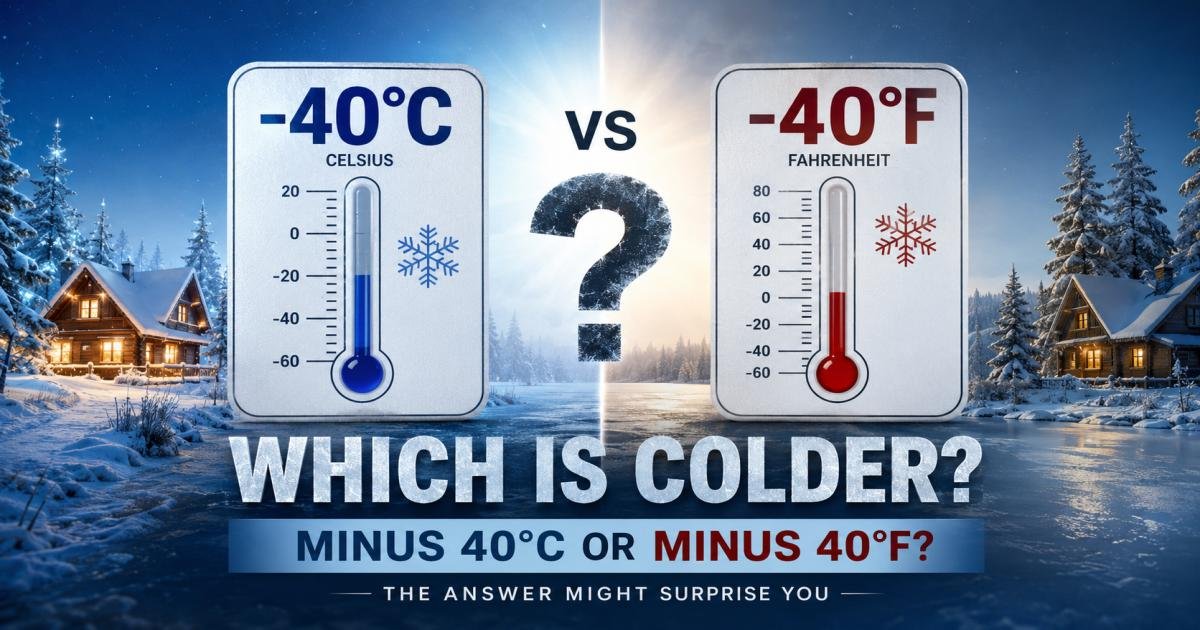

Neither one is colder. Minus 40°C and minus 40°F are the exact same temperature.
This sounds like a trick question, but it is a genuine scientific fact. At exactly 40 degrees below zero, the Celsius and Fahrenheit temperature scales intersect. If you step outside in the Arctic and your thermometer reads -40, you do not need to check which scale it uses.
Here is exactly how the math works, why these two completely different measurement systems overlap, and what negative 40 degrees actually feels like in the real world.
Which is Colder: Minus 40°C or Minus 40°F?
To state the answer immediately: neither one is colder.
They represent the exact same level of heat energy in the air. This point of equality is the only place on the entire temperature scale where the Celsius and Fahrenheit systems perfectly align.
Why -40°C and -40°F Are Exactly the Same
These two scales meet at minus 40 because they advance at different rates. A change of one degree in Celsius represents a larger shift in actual heat than a change of one degree in Fahrenheit. Because they start at different freezing points and move at different speeds, their mathematical lines eventually cross.
The Celsius-to-Fahrenheit formula
Meteorologists and scientists use a specific mathematical formula to convert a temperature from Celsius to Fahrenheit. You multiply the Celsius temperature by 1.8 (or $\frac{9}{5}$) and then add 32.
The formula is:
This equation demonstrates that Fahrenheit grows faster than Celsius as temperatures rise, and drops faster as temperatures fall.
The Fahrenheit-to-Celsius formula
To convert Fahrenheit into Celsius, you reverse the math. You subtract 32 from the Fahrenheit number, and then multiply the result by $\frac{5}{9}$.
The formula is:
What happens when you plug in -40
If we take the Celsius-to-Fahrenheit formula and plug in the number -40, the math proves the overlap.
First, multiply -40 by 9, which gives us -360. Divide that by 5, which equals -72.
Add 32 to -72, and you get your final answer:
F = -40
Minus 40 degrees Celsius equals exactly minus 40 degrees Fahrenheit.
A Quick Temperature Scale Refresher
Understanding why these scales differ everywhere except at -40 requires a quick look at how their creators designed them.
What Celsius measures
Swedish astronomer Anders Celsius invented this scale in 1742 based entirely on water.
Water freezes into ice at 0°C and boils at 100°C at sea level. Because it splits perfectly into 100 degrees, scientists often call it the centigrade scale. This simple, logical structure makes it the standard choice for science and daily life across most of the globe.
What Fahrenheit measures
Physicist Daniel Gabriel Fahrenheit created his scale in 1724. He set 0°F as the freezing point of a specific brine mixture of water, ice, and salt.
Under the Fahrenheit system, fresh water freezes at 32°F and boils at 212°F. Because this scale packs more degrees between freezing and boiling (180 degrees versus the 100 in Celsius), it tracks smaller changes in daily weather.
Why different countries use different scales
Almost the entire world uses Celsius. It aligns perfectly with the metric system, measuring everything in simple multiples of ten.
The United States, alongside a few island nations, continues to use Fahrenheit for daily weather. The U.S. kept the British imperial system of measurement long after the British transitioned toward the metric system.
Why -40 Feels So Extreme in Real Life
Experiencing negative 40 degrees in person shocks the human body. This level of cold requires heavy preparation and specialized winter gear.
What happens to skin, breath, and metal in deep cold
At -40, exposed skin develops frostbite in 5 to 10 minutes. The moisture in your eyes and nose freezes rapidly. When you exhale, the water vapor in your breath turns into tiny ice crystals instantly, creating a visual effect known as “diamond dust.”
The physical world also changes. Standard steel becomes brittle and can shatter upon impact. Rubber car tires freeze solid; if you drive a vehicle that sat outside overnight, the tires remain flat on the bottom. Boiling water thrown into the air vaporizes instantly into a cloud of snow.
Why wind chill makes it feel even harsher
Thermometers measure actual air temperature, but they ignore wind. Wind chill measures how cold the air feels on human skin as wind strips away our body heat.
If the air is -40 and the wind blows at just 15 mph (24 km/h), the wind chill factor drops to -63°F (-53°C). Under these specific conditions, frostbite damages exposed skin in less than two minutes.
Why this matters in travel, work, and winter safety
For people working in the Arctic, Alaska, or Siberia, minus 40 presents a major operational hazard. Normal engine oil thickens into jelly. Drivers must leave vehicles running constantly or plug them into engine block heaters overnight.
Winter safety protocols mandate multiple layers of insulated clothing, emergency thermal blankets, and strict rules against solo travel. A vehicle breakdown at -40 quickly becomes a survival situation.
Easy Comparison Examples
To see how these scales compare outside of the extreme -40 mark, look at three everyday temperatures.
| Celsius | Fahrenheit | Real-World Context |
| 0°C | 32°F | Water freezes. Rain turns to snow and black ice forms. |
| 10°C | 50°F | Brisk autumn weather. Requires a light jacket. |
| 40°C | 104°F | Extreme summer heatwave. Requires constant hydration. |
Common Mistakes People Make
Temperature conversions confuse people constantly. Here are the traps people fall into when trying to compare Celsius and Fahrenheit.
Thinking the larger negative number is always colder
People assume that because 100°F is hotter than 100°C, the same rule applies below zero. However, the scales flip. For example, -20°F (-28.9°C) is physically colder than -20°C (-4°F). Assuming one scale is permanently “colder” leads to inaccurate weather assessments.
Mixing up “difference” and “temperature”
A shift of 10 degrees Celsius does not equal a shift of 10 degrees Fahrenheit. Because the scales stretch at different rates, a 1°C increase equals a 1.8°F increase. Adding or subtracting the same amount from both scales simultaneously produces the wrong numbers.
Forgetting the conversion formula
Many people estimate conversions by simply adding 30 to the Celsius number. While $0°C + 30 = 30$ (which is very close to the actual 32°F), this shortcut fails quickly. If you try that trick with 40°C, you get 70°F—which misses the real answer of 104°F by a massive margin.
Real-World Places Where -40 Matters
Negative 40 degrees happens regularly in specific parts of the world and inside specialized industries.
Weather reports
Towns like Oymyakon and Yakutsk in Siberia routinely see temperatures drop below -40 in January, occasionally plunging to -60°C. Weather stations in the Canadian Yukon, Alaska, and Antarctica report these extreme lows every winter.
Science and engineering
Aerospace engineers test satellite components in environmental chambers chilled to -40 and below to ensure metals survive high altitudes. Medical laboratories use specialized deep freezers set between -40°C and -80°C to safely store vaccines and biological samples.
Cold-climate travel and survival
Expeditions to the high Arctic require gear rated specifically for this temperature threshold. Standard winter boots fail at -40; travelers need boots with thick, insulated rubber soles to stop the frozen ground from extracting heat from their feet.
Final Takeaway
Minus 40°C and minus 40°F represent the exact same temperature, making this the only point where both scales perfectly align. This rare mathematical overlap happens because Celsius and Fahrenheit advance at completely different numerical rates. Beyond the equations on a page, experiencing negative 40 degrees in reality means facing dangerous, life-threatening cold. Ultimately, whether your thermometer reads in metric or imperial, reaching this number means you need to find immediate warmth.
FAQs About -40°C and -40°F
Is -40°F colder than -40°C?
No. They are exactly the same temperature. It is the one specific point where the Fahrenheit and Celsius scales perfectly intersect.
Why do Celsius and Fahrenheit meet at -40?
They meet because they start at different baseline numbers and advance at different mathematical rates. One degree of Celsius represents a larger change in heat than one degree of Fahrenheit, causing their lines to cross at exactly -40 on a graph.
Which scale is more common worldwide?
Celsius is the primary scale worldwide. It serves as the official temperature scale for almost every country on Earth, while Fahrenheit remains common only in the United States and a few smaller territories.
Is there any temperature where Celsius and Fahrenheit are both the same again?
No. Because they are straight mathematical lines moving at different angles, they only intersect at one single point. They never match up at any other number.




[…] Also Read: Which is Colder: Minus 40°C or Minus 40°F? The Real Answer Explained […]